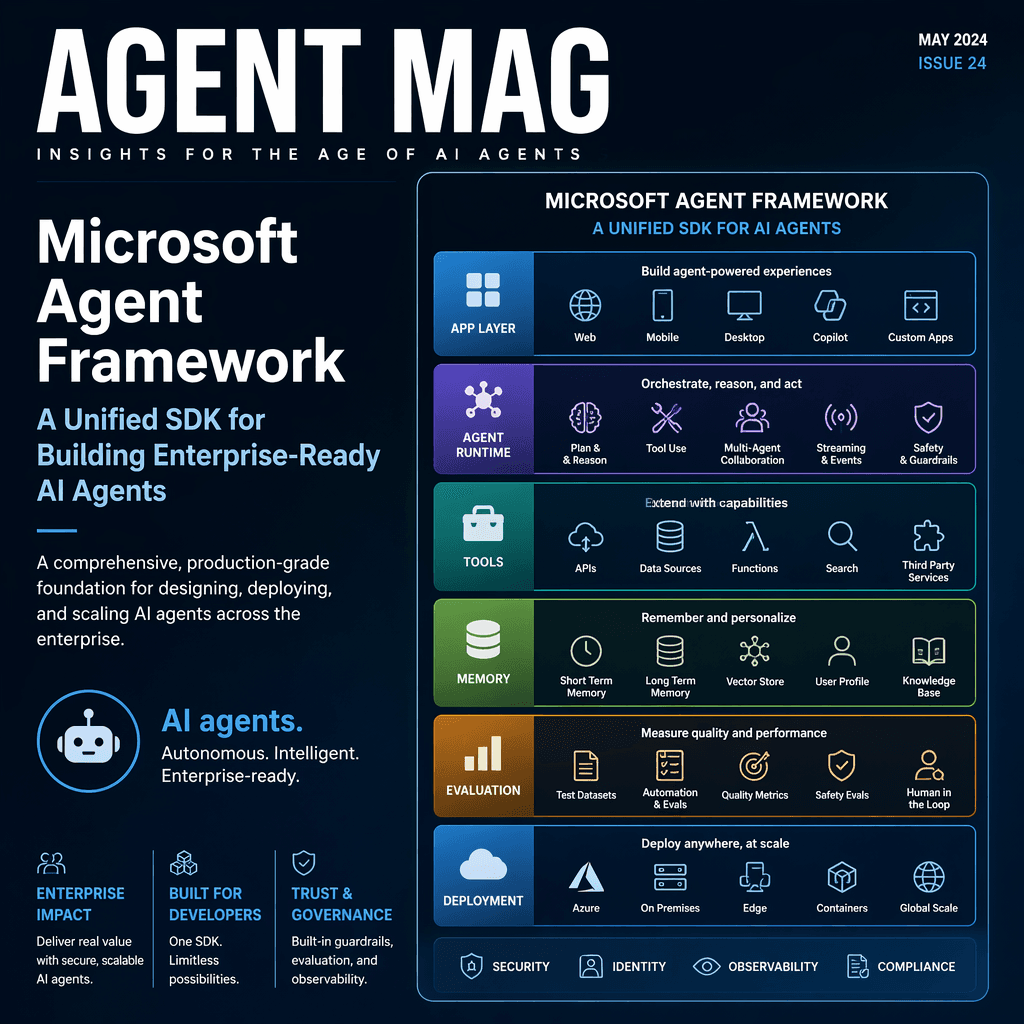
Microsoft Agent Framework: Bridging Innovation and Enterprise Readiness
The rapid evolution of AI agents has sparked a wave of experimentation among developers, but transitioning from prototype to production remains challenging. Microsoft Agent Framework, an open-source SDK and runtime, aims to address these hurdles by unifying the experimental orchestration capabilities of AutoGen with the enterprise-grade stability of Semantic Kernel.
Why Microsoft Agent Framework Matters
AI agents are no longer confined to simple chatbot functionalities. They now serve as autonomous software components capable of reasoning, collaborating, and adapting dynamically. However, existing frameworks often lack interoperability, enterprise readiness, and seamless scalability. Microsoft Agent Framework tackles these issues head-on, offering:
- Open standards and interoperability: Ensures portability and vendor neutrality.
- Research-to-production pipeline: Integrates cutting-edge orchestration patterns into enterprise-ready systems.
- Community-driven extensibility: Modular design with pluggable memory and declarative agent definitions.
- Enterprise-grade features: Observability, security, compliance hooks, and long-running durability.
Key Features of Microsoft Agent Framework
Microsoft Agent Framework builds on the strengths of Semantic Kernel and AutoGen, providing a unified foundation for multi-agent systems. Key features include:
- Interoperability: Supports MCP (Model Context Protocol), A2A (Agent-to-Agent communication), and OpenAPI-first design.
- Memory Management: Offers pluggable memory across first-party and third-party stores, enabling persistent and adaptive memory.
- Orchestration: Combines deterministic and dynamic orchestration for both creative reasoning and structured workflows.
- Enterprise Readiness: Includes telemetry, approvals, CI/CD integration, and security features like Azure AI Content Safety.
Integration Across Microsoft’s Ecosystem
Microsoft Agent Framework aligns with the Microsoft 365 Agents SDK and Azure AI Foundry Agent Service, providing a unified set of abstractions for creating, running, and scaling agents. Developers can prototype locally, debug with consistent telemetry, and seamlessly scale into enterprise-grade hosting environments.
Practical Applications
Enterprises are already leveraging Microsoft Agent Framework for diverse use cases:
- KPMG: Automating audit testing and documentation with Clara AI.
- Commerzbank: Enhancing customer support with avatar-driven interactions.
- BMW: Analyzing vehicle telemetry in near real-time to accelerate design cycles.
- Fujitsu: Integrating advanced orchestration strategies into customer solutions.
Builder Note
Microsoft Agent Framework is designed to empower developers with the tools they need to build robust, scalable, and innovative multi-agent systems. Its modular architecture and enterprise-grade features make it a compelling choice for teams aiming to bridge the gap between experimentation and production.
Source Card
{"title":"Introducing Microsoft Agent Framework: The Open-Source Engine for ...","source":"Microsoft DevBlogs","url":"https://devblogs.microsoft.com/foundry/introducing-microsoft-agent-framework-the-open-source-engine-for-agentic-ai-apps","body":"Microsoft Agent Framework unifies Semantic Kernel and AutoGen to provide a robust foundation for building multi-agent systems."}
Key Takeaways
- Microsoft Agent Framework combines innovation and enterprise readiness.
- Supports open standards like MCP, A2A, and OpenAPI.
- Enables seamless transition from prototype to production.
- Offers extensibility through modular design and community contributions.
- Integrates deeply with Microsoft’s ecosystem for scalable deployment.
Pull Quote
"Microsoft Agent Framework doesn’t replace Semantic Kernel and AutoGen - it builds on them, offering one foundation to move from experimentation to enterprise deployment without compromise."
Table
{"headers":["Signal","Why it matters"],"rows":[["Open Standards","Ensures interoperability and portability across frameworks"],["Enterprise Readiness","Provides observability, security, and compliance hooks"],["Modular Design","Allows for community-driven innovation and extensibility"],["Unified SDK","Combines research innovation with production-grade stability"]]}
Code Example
import { AgentFramework } from 'microsoft-agent-framework';

const agent = new AgentFramework.Agent({
name: 'ResearchAssistant',
tools: [
{ name: 'WebScraper', type: 'OpenAPI', url: 'https://api.example.com/scraper' },
{ name: 'DataAnalyzer', type: 'MCP', endpoint: 'mcp://data.analyzer' }
],
memory: {
store: 'Redis',
options: { host: 'localhost', port: 6379 }
}
});

agent.run();
FAQs
{"q":"What is MCP in Microsoft Agent Framework?","a":"MCP stands for Model Context Protocol, enabling dynamic discovery and invocation of external tools or data servers."}
{"q":"Can Microsoft Agent Framework handle long-running workflows?","a":"Yes, it supports long-running durability with retry and error-handling logic."}
References
{"items":["https://devblogs.microsoft.com/foundry/introducing-microsoft-agent-framework-the-open-source-engine-for-agentic-ai-apps"]}
Image Prompts
{"role":"cover","alt":"Microsoft Agent Framework logo with multi-agent system diagram","prompt":"Editorial thumbnail showing Microsoft Agent Framework logo, multi-agent system diagram, and enterprise-grade features."}
{"role":"inline","placementAfterBlock":3,"alt":"Diagram of Microsoft Agent Framework architecture","prompt":"Detailed diagram showing the architecture of Microsoft Agent Framework, including Semantic Kernel and AutoGen integration."}
{"role":"inline","placementAfterBlock":8,"alt":"Visual representation of enterprise-grade features","prompt":"Illustration highlighting enterprise-grade features like observability, security, and compliance hooks in Microsoft Agent Framework."}
Category
"AI Agents | Models | Infrastructure | Tools | Engineering"
Tags
["AI agents","multi-agent systems","Microsoft Agent Framework","Semantic Kernel","AutoGen"]
TLDR
"Microsoft Agent Framework unifies innovation and enterprise readiness, enabling developers to build scalable, secure, and interoperable multi-agent systems."
Focus Keyword
"Microsoft Agent Framework"
Secondary Keywords
["multi-agent systems","Semantic Kernel","AutoGen integration","enterprise AI agents"]
Citations
[{"url":"https://devblogs.microsoft.com/foundry/introducing-microsoft-agent-framework-the-open-source-engine-for-agentic-ai-apps","title":"Introducing Microsoft Agent Framework: The Open-Source Engine for ...","source":"Microsoft DevBlogs"}]